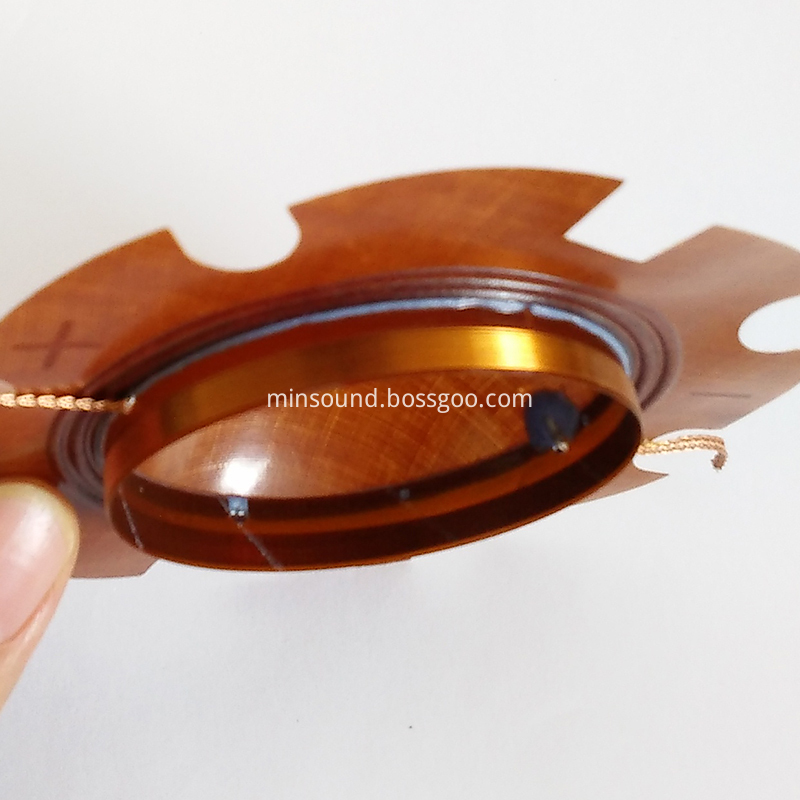
The voice coil is basically composed of a winding cylinder [spool], a winding coil, a pressing lead wire and a pressing paper. During the voice coil task, local electric energy will be converted into heat energy, and the temperature of the voice coil can reach the "very hot" level. Therefore, the material of the spool is necessary and must be heat-resistant. Aluminum foil is usually used, and the aluminum foil itself can also be used for heat dissipation. Heat resistant plastics and fireproof paper are also used.
Wires shall not be exposed and their surfaces shall be covered with insulating materials. The coil is also the decisive factor of the horn speaker/power, while the "horn burning" actually burns the voice coil, because the wire of the voice coil burns through the insulation, so it cannot work. The higher the temperature that the insulating material can withstand, the greater the function that the voice coil can carry. Therefore, the insulating layer becomes one of the cruxes of power improvement. Some loudspeakers are advertised to be coated with XXX low temperature resistant coating, which means that the insulation layer is low temperature resistant.
The voice coil is suspended in the magnetic gap and contacts with the air. The air is a bad conductor of heat, which promotes the carrying function of the voice coil. Injecting magnetic fluid into the magnetic gap can increase the heat dissipation efficiency. Of course, the role of magnetic fluid is not only to dissipate heat, but also to increase damping, which has an impact on the response speed of voice coils and the sensitivity of speakers.
The material section of the winding coil is generally a circular conductor, because the processing of the circular cross-section conductor is simple, but the effectiveness of the circular conductor is not. It can be clearly understood by looking at the voice coil section. The round wire voice coil will waste a lot of section space, while the flat wire voice coil is more suitable for space, which can achieve higher electromagnetic performance under the same volume occupation. However, the old version of the flat wire voice coil is very high, because it is difficult to process and shape the flat wire.
The coil length can be large or small according to the loudspeaker design requirements. In the promotion of many speakers, we often hear such a word - long stroke design. The long stroke design is related to the suspension system, especially the voice coil. If the coil is not long enough, the coil will break away from the magnetic gap, and the force between the coil and the permanent magnet will drop, resulting in a drop in the main force of the speaker. Long stroke voice coil is usually used in the design of medium and small caliber bass speakers. The greater the stroke, the greater the air volume, the more sufficient the low frequency.
There are also differences in winding. Voice coil can be wound into single layer, double layer, four layers or even multiple layers. There are two winding methods: horizontal winding and continuous winding. Different windings will lead to different electromagnetic conversion efficiency, and inductance will also be different. The total length of the wires also affects the voice coil. The self weight of the voice coil will also affect the conversion efficiency. The higher the conversion efficiency, the higher the high-frequency response capability. Here is a brief mention. If you are interested, please refer to the professional materials.
Conductor materials are also different. Copper and aluminum wires are usually used. Aluminum has low density and high efficiency, but aluminum wire is difficult to weld, so copper clad aluminum wire appears, that is, aluminum wire is covered with copper film. Copper clad aluminum wire better balances the relationship between material processing and self weight. Many manufacturers do not want to indirectly tell you what copper clad aluminum is, but refer to a "CCAW". In fact, it is the same, but CCAW looks foreign. Copper clad aluminum wire is widely used in the design of earphone speakers, because these horn speakers are very sensitive to the weight of voice coils.