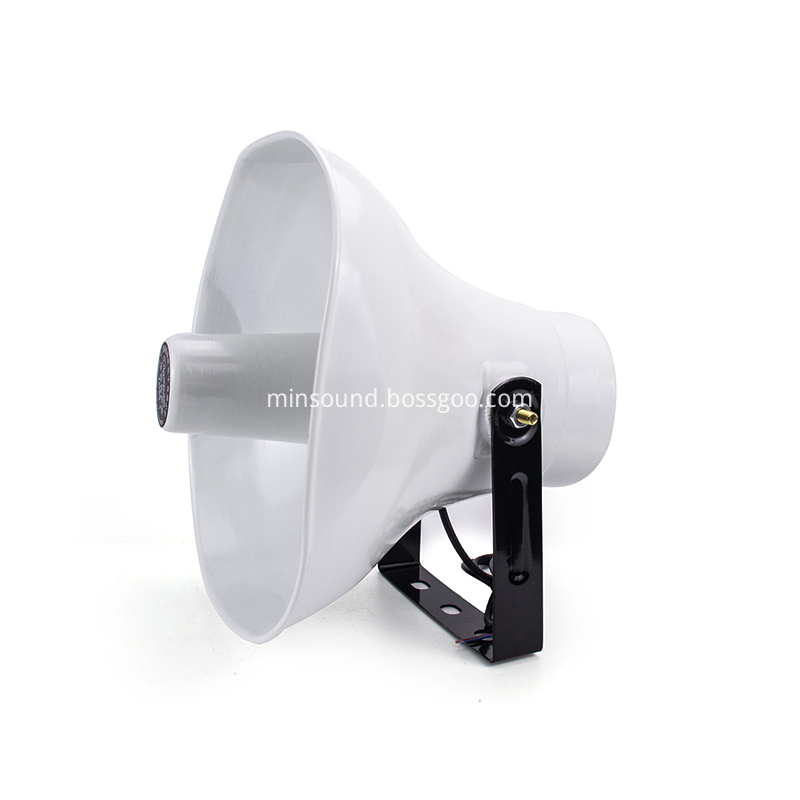
Let's first examine the impact of power and sensitivity on the horn speaker.
At high power and sensitivity, the speaker has the highest volume; When high-power is at low sensitivity, or when low-power is at high sensitivity, the volume of the speaker is moderate; When the power is low and the sensitivity is low, the sound of the horn is the smallest.
For example, if the power of a speaker is 500W and the sensitivity is 98dB, the output volume is the same as if the power of a speaker is 1000W and the sensitivity is 95dB. In contrast, the power of the latter is twice that of the former, while the output volume is the same, meaning that for every 3dB difference in sensitivity, the power needs to be doubled to achieve the same volume.
Generally speaking, the higher the power and power of a horn, the louder the sound, which is relatively speaking. For example, when combined with sensitivity, it is a different matter.
Let's look at the impedance again. The impedance of a typical horn can be 2 Ω, 4 Ω, 6 Ω, etc. The level of impedance can change the output power of the system.
Under the same signal strength, the lower the impedance of the horn, the greater the output power. For example, an output power of 4 Ω will be greater than the output power of a high impedance horn of 8 Ω.
On the surface, low impedance can increase power, but it doesn't mean that the lower the impedance, the better. Too low impedance can cause overload of the power amplifier to malfunction. This is why when matching speakers with amplifiers, it is important to pay attention to the impedance of the speakers and the power of the amplifiers. If not properly matched, it can cause poor sound and damage to the equipment.
Finally, let's take a look at the frequency response. The frequency response of a speaker, in simple terms, refers to the range of sound frequencies that the speaker can reproduce to an appropriate volume when playing music or sound effects.
In daily life, the frequency response of speakers is commonly labeled as 50Hz -20kHz (+/-3dB), 50Hz -21kHz (+/-3dB), etc. In this way, it indicates that when receiving signals of the same voltage and different frequencies, the response volume change of 50Hz to 20kHz or 50Hz to 25kHz is within+/-3dB, which is a common standard.
However, ultra-low or Super high frequency, such as 15Hz, 22kHz, may be -4dB, -5dB or more. If the volume drops too low and the response is too poor, it will not be included in the frequency response range.
The lower the decibel value of the frequency response, the flatter the frequency response curve of the speaker, the smaller the distortion, and the better the music reproduction. So, frequency response is an important indicator for evaluating the quality of speakers.
In addition, the complex environment inside the car ultimately determines the sound quality of the speakers, as well as installation layout and debugging.
Moreover, there are various types of speakers available, including crossover speakers, full frequency speakers, coaxial speakers, etc. When deciding to purchase a speaker, the quality of the speaker is not only determined by the power level, but also by considering all aspects comprehensively, in order to obtain the ideal speaker.