

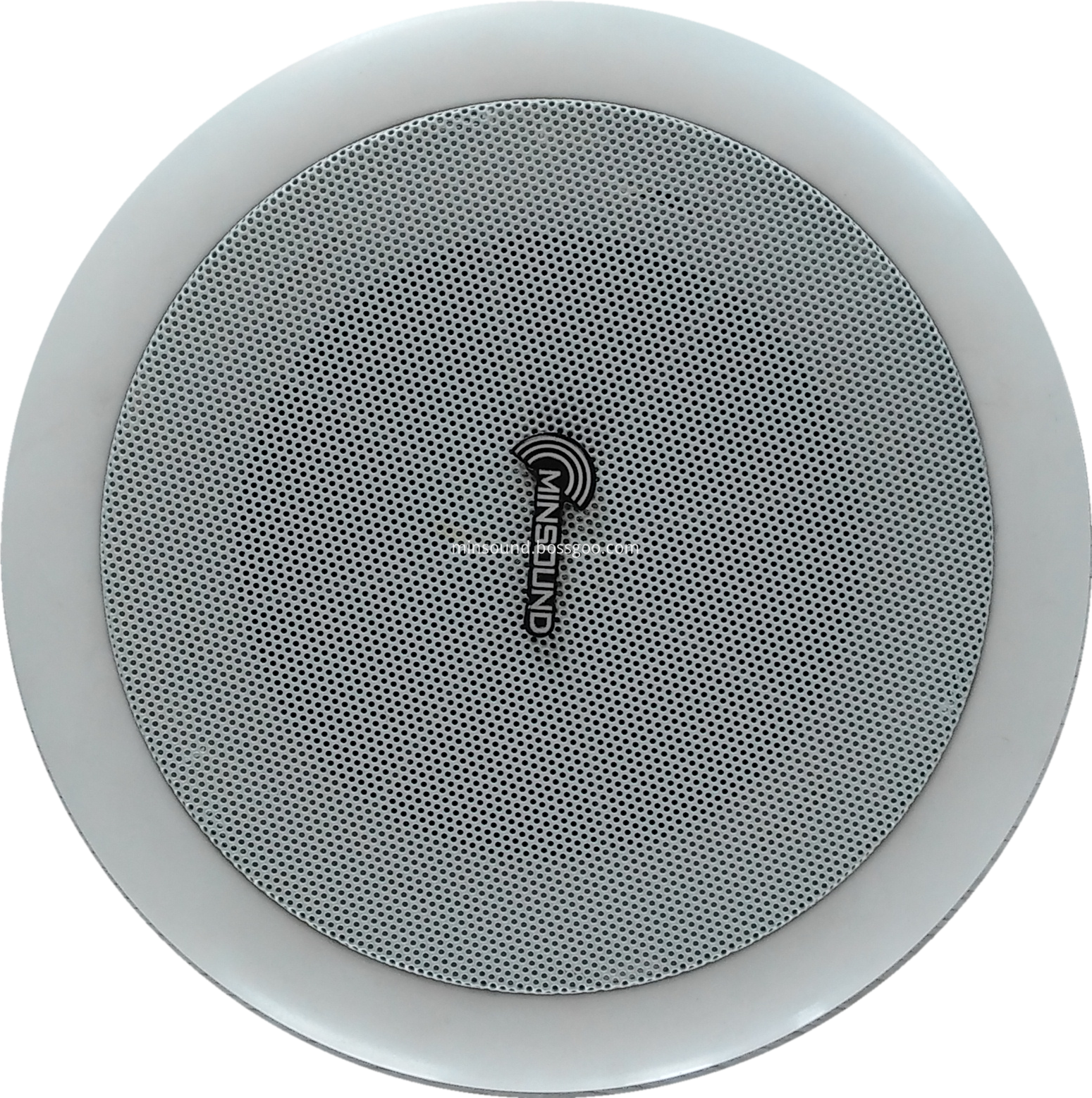
1. The rated voltage of constant pressure ceiling speakers is certain. The speakers of the constant pressure system are connected in parallel. As long as the total power of the speakers does not exceed the total power of the constant pressure power amplifier, many ceiling speakers can be connected. Building speakers. As long as it does not exceed the total power of the amplifier.
2. The constant resistance ceiling speaker needs to be matched with the output impedance of the constant resistance power amplifier, and the load resistance of the constant resistance system is certain. In a constant resistance power amplifier, if the load impedance changes, the power changes accordingly. 8 ohm 100W constant resistance power amplifier connected to 4 ohm becomes close to 200W. The constant resistance power amplifier is connected to the fixed resistance ceiling speakers, which cannot be increased arbitrarily, and can only be increased after calculation by professional engineers.
Application places of constant pressure loudspeaker and constant resistance loudspeaker:
1. Constant pressure audio is mainly used in public broadcasting in public places, campus broadcasting, and background music systems. The constant voltage power amplifier adopts high voltage and low current output, and the line loss is small. The distance between the public broadcasting speaker and the power amplifier can be farther, and a power amplifier usually needs to be connected to multiple low-power speakers.
The constant pressure broadcasting system can reduce the line loss and prevent the opening or closing of a speaker in the system from affecting the volume of other speakers. The constant pressure broadcasting system power amplifier can be connected to multiple speakers, as long as the speakers are connected in parallel on a common wire.
2. The constant resistance system is mostly used in conference audio, home background music, home theater, KTV, stage, etc. Home background music, home theater, stage and other speakers are relatively close to the power amplifier, and there is no need to connect a lot of speakers. At the same time, home background music, home theater, and professional audio have higher sound quality requirements. The emphasis is on the sound effect. The sound is amplified through the power amplifier. The final mixing thickness and clarity are the hard indicators of the entire sound system. The constant resistance power amplifier adopts high current and low voltage output, and the connection of the power amplifier and the sound response selects a dedicated speaker line.
The difference between the sound quality of constant pressure speakers and constant resistance speakers
Constant pressure speakers are used in large spaces where the sound quality is not very high. On the contrary, constant resistance can only transmit within 100 meters due to transmission limitations, so the sound effects are generally better when used in small spaces. Because the constant voltage amplifier uses a transformer on the circuit, its sound quality is affected to a certain extent. However, if you choose high-quality broadcast speakers, you can completely improve the sound quality of the broadcast system.
3. Matching characteristics of constant resistance sound system and constant pressure sound system:
A simple understanding of constant voltage power amplifier is to drive the speaker with voltage. Its characteristics are that the output voltage is large and the current is small; the constant resistance power amplifier uses current to drive the speaker. , you can't even hear it; the power amplifier of constant pressure is connected to the speakers of constant resistance, and the speakers are burned.
Speaker size and sound effects:
The larger the diameter of the speaker unit's diaphragm, the larger the volume of air pushed, and the more obvious the sound pressure; in short, it is easier to excite the air, giving people a feeling of airflow impact. The low frequency response will be better, and the sound felt by the human ear will be better. Of course, it must be matched with the power amplifier, power and so on. The larger the magnetite, the stronger the magnetism. The stronger the magnetism, the more efficient the speaker will be at the same power received, the louder it will be, and the more controllable it will be!
Coaxial speakers:
In general speakers, the tweeter and woofer are arranged on the panel of the speaker, so their sounding centers cannot coincide with a point. In this way, the distance between the tweeter and the bass reaching the listener will be different, and this difference will lead to The phase deviation thus affects the correct restoration of the sound image. The coaxial speaker uses a coaxial unit, which is actually a combination of a tweeter unit and a woofer unit. , thus solving the problem of phase deviation.
Crossover speakers:
The frequency divider is the "brain" in the speaker, which is used to separate the input music signal into different parts such as treble, midrange and bass, and then send them to the corresponding high, medium and woofer units for playback. The frequency divider can be divided into two, three and four frequency division according to the frequency division frequency band. Two-frequency division is to divide the entire frequency band of the audio signal into two frequency bands, high frequency and low frequency; Ultra low frequency.
The crossover point refers to the intersection of the frequency response curves of two adjacent speakers (such as treble and bass in two-way, treble and midrange in three-way, midrange and bass) at a certain frequency, usually It is the frequency at half of the power output of the two speakers (that is, the -3dB point), which is determined according to the frequency characteristics and distortion of the speaker and each speaker. Usually, the dividing point of the two-frequency divider is between 1KHZ~3KHZ, and the three-frequency dividing point is 250HZ~1KHZ and 5KHZ.
Measure six performance indicators of speaker sound quality:
1 Speaker frequency response range: The full name of the frequency response range is called frequency range and frequency response. The former refers to the range between the lowest effective playback frequency and the highest effective playback frequency of the speaker system; the latter refers to the sound pressure generated by the speaker when an audio signal output at a constant voltage is connected to the system with the change of frequency. The phenomenon of increasing or attenuating, and the phase changing with frequency, the correlation between the sound pressure and the phase and the frequency is called the frequency response, the unit is decibel (dB). The curves of sound pressure and phase lag with frequency are called "amplitude-frequency characteristics" and "phase-frequency characteristics", collectively referred to as "frequency characteristics". Direct relationship, the smaller the decibel value, the flatter the frequency response curve of the speaker, the smaller the distortion, and the higher the performance. 2.
2 Speaker sensitivity; this indicator refers to the sound pressure level measured at a distance of one meter from the vertical center axis of the speaker plane when a 1W/1kHz signal is input to the speaker input. The unit of sensitivity is decibel (dB). For every 3dB difference in the sensitivity of the speaker, the output sound pressure is doubled. The sensitivity of ordinary speakers is in the range of 85 to 90dB. The sensitivity of ordinary speakers is in the range of 85dB to 90dB. The sensitivity of less than 85dB is low, and the sensitivity of more than 90dB is high.
3 Speaker power: This indicator simply means that you can feel how powerful the sound from the speaker can be. According to international standards, there are two ways of marking power: rated power and withstand power (instantaneous power or peak power PMPO). The rated power refers to the undistorted power that the speaker can send out by giving the speaker a continuous analog signal with a specified waveform within the rated frequency range, and the withstand power is the electrical power that does not cause any damage to the speaker. Usually, in order to cater to the psychology of consumers, businesses usually set the music power very high, so the rated power should prevail when purchasing multimedia speakers.
4 Distortion degree: The definition of the distortion degree of a speaker is basically the same as that of the amplifier. The difference is that the amplifier inputs an electrical signal and outputs an electrical signal, while the speaker inputs an electrical signal and outputs a sound wave signal. Therefore, the distortion of the speaker refers to the distortion of the electro-acoustic signal conversion. The allowable range of sound wave distortion is within 10%, and the average human ear is not sensitive to distortion within 5%. Don't buy speakers with more than 5% distortion.
5 Signal-to-noise ratio: This indicator refers to the ratio of the normal sound signal to the noise signal played back by the speaker. The signal-to-noise ratio is low, the noise is serious when the small signal is input, and the sound in the entire sound range becomes obviously turbid and unclear, and I don't know what sound is issued, which seriously affects the sound quality. Speakers with a signal-to-noise ratio below 80dB (including subwoofers below 60dB) are not recommended for purchase.
6 Speaker impedance: This indicator refers to the ratio of the voltage to the current of the input signal. The input impedance of speakers is generally divided into two types: high impedance and low impedance. Generally, those higher than 16 ohms are high impedance, and those lower than 8 ohms are low impedance. The standard impedance of speakers is 8 ohms. The nominal impedance of speakers on the market is 4 ohms, 5 ohms, 6 ohms, 8 ohms, 16 ohms, etc. Although this indicator has nothing to do with the performance of the speakers, do not buy speakers with low impedance, the recommended value is the standard 8 Ohm, this is because in the case of the same power amplifier and output power, low-impedance speakers can obtain larger output power, but if the impedance is too low, it will cause damping and bass degradation.
Ceiling speaker opening, wiring, installation and debugging
The specifications of ceiling speakers are different, usually 4 inches, 5 inches, and 6 inches. The opening diameter can be opened according to the opening size specified in the instructions of each ceiling speaker or the manufacturer's atlas. In actual construction, it can be slightly larger. A little bit, it's easier to install.
Constant pressure ceiling speaker wire usually uses RVS2*1.5 twisted pair wire for indoor iron pipe, and RVV2*1.5 sheath wire is usually used outdoors. If the project site is large, in order to reduce line loss, thicker signal wire can be used. Various external interference signals at the scene are large and the distance is long, and the RVVP sheathed cable with shield can be used, which can sometimes solve various uncertain problems such as noise and humming. For public broadcasts that require fire-fighting broadcast linkage with a strong-cut volume control, a separate power cord for 24V strong-cut triggering needs to be laid.
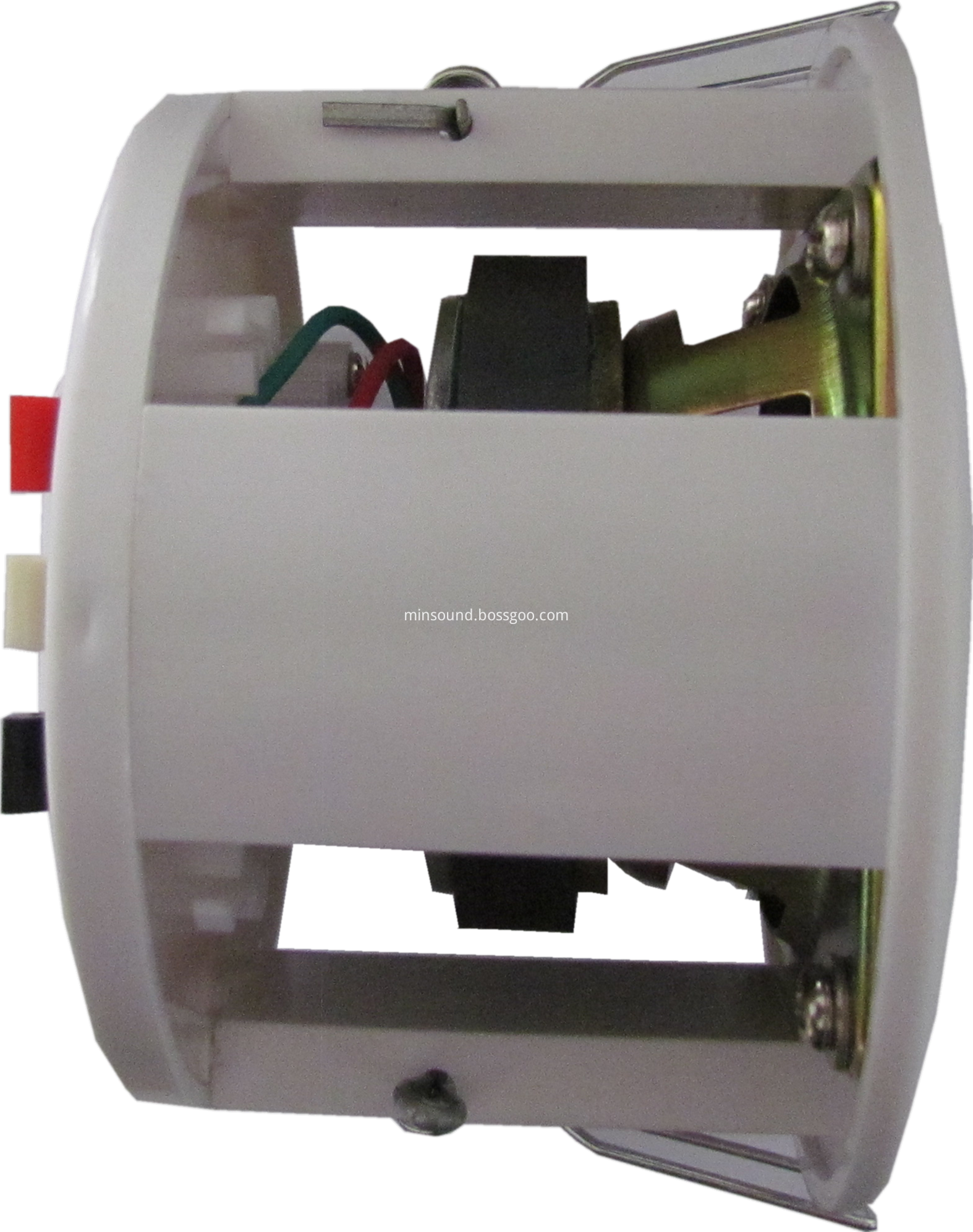
The fixed resistance ceiling speaker wire usually adopts the professional speaker wire, the scientific name is gold and silver wire, which is a cable with two copper wires, one red and one white, wrapped in transparent rubber. Usually "branch" is used to represent the unit, there are 100, 150, 200...