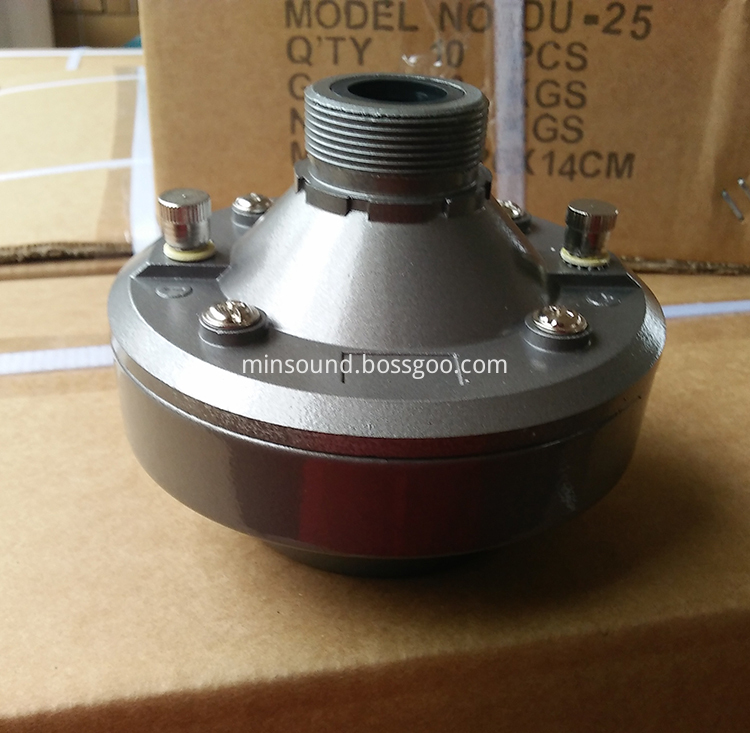
Magnets play a significant role in driving PA loudspeaker. The bigger the magnet, the stronger the potential driving force of the speaker (assuming the magnetic strength of the magnet is constant). Small magnets are for small speakers and produce, by nature, [weaker sound", while bigger magnets make bigger speakers capable of producing louder sound.
Stronger/bigger magnets will allow for louder sound production. Other factors necessary for louder volume include stronger (more amplified) speaker level audio signals, more heat-resistant voice coils, larger cone/diaphragms, greater room for diaphragm excursion, more optimal speaker enclosure and more. In short, a bigger magnet is one of the factors that allows a loudspeaker to sound louder.
But does this constitute the oft subjective term [better"?
Yes, bigger magnets make for better loudspeakers if we're only concerned with loudness. They make for louder speakers, which are especially important for sound quality in large rooms.
For example, a large 2-way PA speaker will fill a room much better than the built-in speakers of a laptop or tablet. However, it's not only the fact that the PA speakers contain bigger magnets; they also feature the factors I've listed above.
All else being equal, a bigger permanent magnet will increase the reactivity of the speaker to the pulses of electricity running through the electromagnetic voice coil.
However, you've likely noticed on high-end speakers that there are often multiple driver sizes. That is because, when it comes to frequency response, larger speakers are typically better at producing low-end/bass frequencies, and smaller speakers are generally better at producing high-end/treble frequencies.
To reproduce the entire audible frequency spectrum (20 Hz – 20,000 Hz), we tend to rely on a variety of speaker driver sizes, each optimized to produce its own frequency band within the audible range. This is a drawback of electrodynamic speakers, though it is one that we've understood and incorporated into loudspeaker design for quite some time.
Subwoofers, for example, will have very large magnets (along with robust voice coils and great diaphragms). Their purpose is to produce low-end frequencies with long wavelengths, which require them to push and pull a lot of air. Note that, as humans, we tend to feel these sub-bass and bass frequencies more than we hear them.
Tweeters, conversely, will have small magnets (along with thinner voice coils and small diaphragms). Their purpose is to produce the high-end frequencies, which have shorter wavelengths and are more easily perceived by our hearing. There's a great benefit of keeping these drivers smaller and allowing them to vibrate very quickly to recreate the high-frequencies.
So a bigger magnet is certainly [better" for subwoofers, woofers and even some midrange speakers (depending on the frequency bands they're designed to produce). However, this is not the case with tweeters, super-tweeters or some other midrange speakers.
Before we move on, it's important to note that the size of the magnet in any given speaker driver is subject to constraints. The overall size and weight of the drivers are factors to consider. How the magnet will interfere with other audio devices (other drivers, crossovers, amplifiers and other components) must be taken into consideration.
It's also essential that the magnet's magnetic field be concentrated in the pocket where the voice coil is suspended. If you questioned the odd shape of the magnet in the illustration I provided earlier, note that the bizarre construction (complete with pole pieces) is to concentrate this magnetic field at the voice coil.