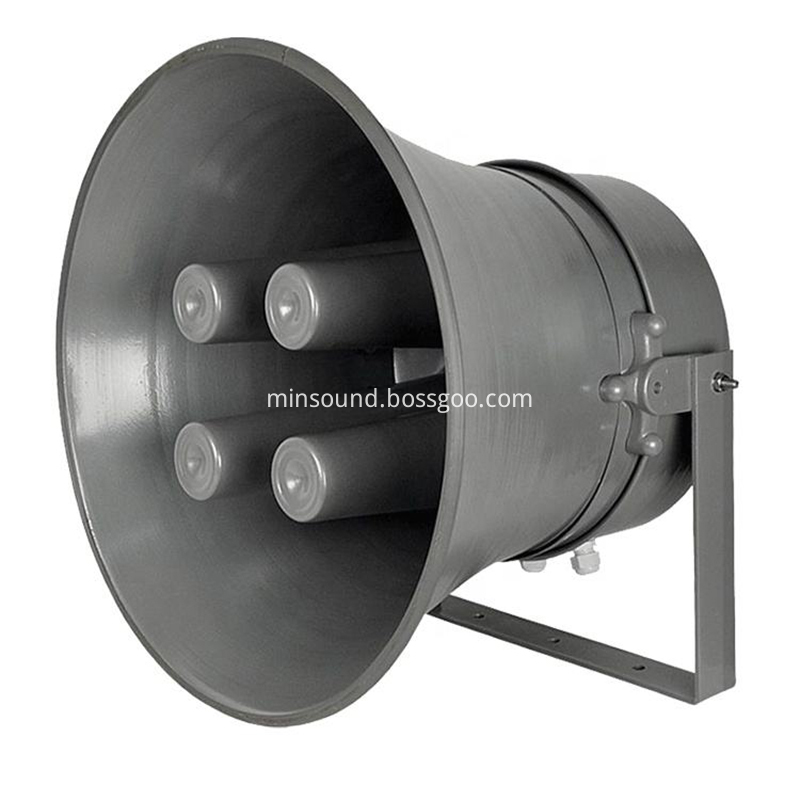
Next, let's look at the working principle of the horn speaker:
When the coil in the speaker is energized, its coil will generate a magnetic field. Under the interaction with the magnetic field of the magnet, the coil will vibrate and the vibration will produce sound, which is the force exerted on the energized conductor in the magnetic field. When the AC audio current passes through the loudspeaker coil (voice coil), the corresponding magnetic field will be generated in the voice coil. The magnetic field interacts with the magnetic field generated by the permanent magnet on the loudspeaker. Therefore, this force makes the voice coil vibrate with the audio current in the magnetic field of the speaker's permanent magnet. The diaphragm of the speaker is connected to the voice coil, so the diaphragm also vibrates. The vibration produces the same sound as the original audio signal waveform.
The horn type loudspeaker has the advantages of strong directivity, high power and high efficiency, so it is widely used in venues, fields, vast fields and other fields. The professional high-frequency loudspeaker has the characteristics of good sound quality and good frequency response, and is mainly used in theaters and other places with high requirements.
The disadvantages of horn type loudspeaker are poor low frequency response, narrow frequency band and easy to produce nonlinear distortion. The main difference between horn type loudspeaker and paper cone electric loudspeaker is indirect radiation, that is, after the diaphragm vibrates, the sound will spread outward through the loudspeaker, which will greatly enhance the sound, so that the sound can be concentrated in one direction and spread farther.