

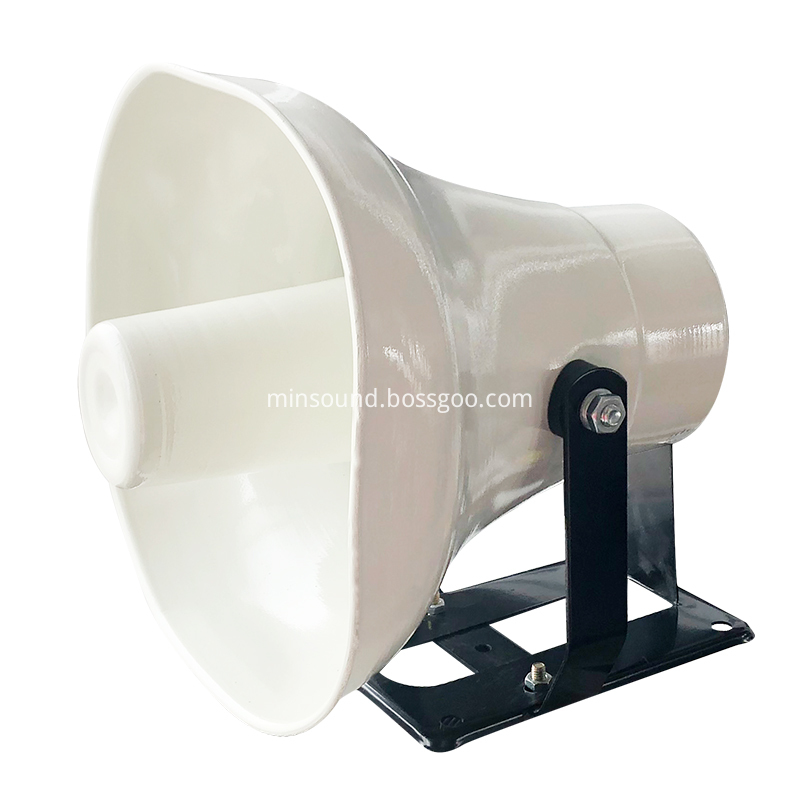
The role of the horn loudspeaker is to change the acoustic load of the diaphragm, so that the diaphragm and the air load can be well matched. Another function of the loudspeaker is to adjust the directivity of the loudspeaker. In order to obtain effective sound radiation, the section of the horn throat expands slowly, which can prevent the sound pressure from suddenly decreasing after the sound wave leaves the diaphragm. The section of the horn outlet is usually large, preventing the sound wave from reflecting back to the horn. According to the different laws of the change of the sectional area of the sound tube horn can be divided into exponential, hyperbolic and parabolic types, among which the exponential type horn is widely used. The high-frequency radiation characteristics of these different types of horn speakers are not very different, but there are obvious differences in the low-frequency radiation characteristics. There is a small space between the driver and the horn throat, which is called the air chamber. When the diameter of the diaphragm is large, the phase difference between the sound wave from the center of the diaphragm and the sound wave from around the diaphragm will occur when they propagate to the horn throat, which limits the playback frequency band. In order to eliminate this phase interference, a special throat plug is designed in the middle of the air chamber. When the audio frequency current passes through the voice coil, it drives the diaphragm to vibrate, which acts on the air chamber between the diaphragm and the horn throat. The sectional area of the horn throat is usually smaller than the sectional area of the diaphragm. Therefore, when the air driven by the diaphragm enters the horn throat with a smaller sectional area than the diaphragm, the air flow rate in the throat increases. This situation is called velocity conversion. The acoustic wave radiated from the diaphragm is compressed when it passes through the horn throat, which will increase the load acoustic impedance of the diaphragm. In general, we design the acoustic impedance of the diaphragm to be close to the force impedance of the diaphragm itself, so that they can match the impedance. Because the cross-sectional area of the horn increases slowly according to different changing laws, the sound waves in the horn are nearly evenly spread outward as plane waves, and the sound waves at the outlet of the horn and the diaphragm vibrate together, so that the horn speaker can radiate sound waves more effectively.